Today’s business environment
has changed fundamentally from the environment of the past. Organisations are faced with unprecedented
levels of turbulence and change, increasing levels of complexity in the
environment and higher expectations from interest parties. No longer can an organisation be responsible
to shareholders alone; those who survive and flourish in the long term are
going to be measured by their ability to satisfy the expectations of a wider
group of interest parties, for example employees, unions, political parties and
environmental groups.
Within this new environment it is
essential to build and develop people within the organisation who are equipped
for these changes – who are aware of the organisation and its purpose, who have
insight into the nature of complexity and of the broader context in which the organisation
functions. People who realise those
simple, quick fix solutions that were appropriate yesterday are obsolete today.
In our experience, the strategic
planning process becomes key in building this strategic competency throughout
the organisation.
However, by strategic
planning we do not mean the traditional annual ‘rain dance’ when the
organisational ‘chiefs’ get together and design intricate plans or blueprints
for the future – these are then filed in the ‘demanding attention’ in-tray.
With the concept of planning
we mean the design of a continuous learning process, a conversational aimed at
changing the mental models of managers.
The important output is not the blueprint or plan, but the learning process
behind the plan. The role of the planner
is not confined to that of the traditional corporate planners, but rather
spread to other areas such as human resources and organisational development
professionals who act as facilitators, catalysers and accelerators of corporate
learning.
The purpose of this article is to
provide managers and professional persons within organisations with a simple
learning activity, which can kick-start strategic thinking, contributing
directly to organisational learning and to changed mental models within the
company.
The activity of stakeholder analysis
provides one with simple guidelines, procedures and practical tools. It involves taking a fundamental look at
stakeholders of the organisation, at their expectations and at how the organisation
can use this information to ensure long-term effectiveness.
 Most
organisations fulfil a need or a function and their existence depends on their
ability to produce outputs required by their function. The majority of commercial organisations have
an explicit moneymaking function, as well as additional soft or ‘implicit’
functions – for example, social responsibility and the promotion of long-term
economic and social welfare of the country.
Most
organisations fulfil a need or a function and their existence depends on their
ability to produce outputs required by their function. The majority of commercial organisations have
an explicit moneymaking function, as well as additional soft or ‘implicit’
functions – for example, social responsibility and the promotion of long-term
economic and social welfare of the country.
Companies mainly succeed in
fulfilling their roles, at least to some level of satisfaction, for the
functions that they recognise as being required. However, organisations often fail, not
because they fulfil an identified function poorly, but rather because they define
their functions too narrowly and fail to recognise that they ought to fulfil a
wider range of functions.
This really boils down to
organisational effectiveness, which is the degree to which an organisation
succeeds in the range of functions applied to it. The words ‘applied to it’ are important,
because a function is nothing but the expectations that various people hold of
the organisation. Now, just the fact
that there is a certain expectation being entertained by an individual or group
does not mean this necessarily becomes a ‘function’ to be fulfilled. However, the reality of the world we live in
is such that if an individual feels strongly about a particular expectation,
through forming pressure groups that person can create an atmosphere wherein the
organisation is perceived to be failing if it does not satisfy the
expectation. This is clearly
demonstrated when looking at the environmental scene, where numerous
organisations were put under immense pressure because of failing to conform to
certain expectations. The question of
organisational effectiveness then becomes one of how well you are doing against
a fan of expectations being held of the organisation.
Organisational effectiveness can be enhanced
through the stakeholder concept. If the
process of organisational effectiveness can be enhanced through the stakeholder
concept. If the process of stakeholder
analysis is applied regularly, it helps the organisation to discover changes in
expectations in time to act and to evaluate the importance of this for its
continued existence.
The approach also allows teams
throughout the organisation to develop contextual insight and understanding and
is thus one way of helping to transform the organisation to a learning
organisation. Even the simple process of
asking, for example, the cleaning team to identify important stakeholders and
their expectations provides greater insight into how they form a part of - and can contribute to – the organisation as
a whole.

The stakeholder analysis process can
be applied at all organisational levels, from the top team to supervisory or
shop floor level. The level of
participation in the exercise will determine the focus. A stakeholder analysis conducted by the top
team will focus on organisational policy and strategy, whilst that conducted at
shop floor level would yield input as to how the particular group can improve
their functioning so as to contribute to broader organisational goals. A broad base of participation at each level
helps to develop common mental models and ensure that there is a higher level
of understanding, commitment and buy-in to further actions.
The stakeholder analysis workshop
should be guided by skilled facilitators, whether these be from corporate
planning, human resources, OD or line management functions. This helps to ‘open up’ the thinking of
participants. The process itself is,
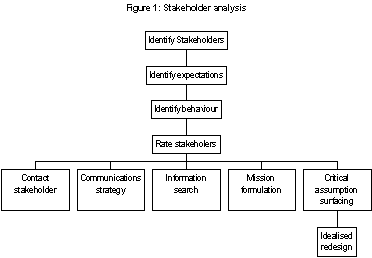
however, simple and easy to follow (see figure 1).
The first step is to identify
important stakeholders of the organisation or the department, depending on the
focus on the activity. A stakeholder is
any person, group or outside party who affects and is affected by the
organisation/department and its policies (see
The next step is to identify the
expectations of stakeholders. For each
stakeholder, specify what you assume the stakeholder expects, or would expect
from the organisation, department, or workgroup. For example: what do parents expect from a
school or educational institution, what do pupils expect and what do teachers
expect from the same school? This
exercise provides insight into the range of expectations that the institution
will have to fulfil in order to be effective.
In order to clarify the importance of these expectations, it is
necessary to also ask: what behaviour do we expect from the stakeholder? Once the range of stakeholders and their
expectations and assumed behaviour has been identified, it is necessary to
determine which stakeholders and expectations are most important to the
organisation.
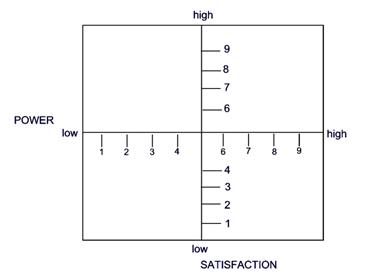
Various criteria assist in rating the
importance of the stakeholders (see
If the organisation chooses to
fulfil the expectation and thus indeed accept the wider function, action plans
need to be developed to ensure that the necessary outputs are produced.
Alternatively, if the organisation wishes
to influence certain stakeholders and change their expectations, some form of
communication strategy should be developed.
 A stakeholder may also be rated as important because
on e is unsure of their expectations or behaviour. In this case a directed search for more
information would increase knowledge about the stakeholder’s value system and
behaviour, enabling more informed decision-making in the future.
A stakeholder may also be rated as important because
on e is unsure of their expectations or behaviour. In this case a directed search for more
information would increase knowledge about the stakeholder’s value system and
behaviour, enabling more informed decision-making in the future.
One of the benefits of cascading a
stakeholder analysis process down the organisation is that it assists in
forming closely knit teams and developing a common language throughout the
organisation. Data generated in the
process can easily be used as input for a mission statement, for example, by
asking the question: what does the organisation want to be or to do for the
most important stakeholders? In mission
development it is suggested that a top-down and a bottom-up process of
identifying important stakeholders and their expectations are superimposed on
each other.
Probably the most important function
of a stakeholder approach is to initiate organisational renewal. The renewal process can be started with an
idealised redesign of the organisation, which produces the vision of what the
organisation should be in the future.
Idealised redesign is a participative process, based on the principles
of the systems approach, which fundamentally revisits the purpose, processes
and organisation of the firm. The
stakeholder analysis is an important starting point of this process, as it
helps to fundamentally revisit the roles that the organisation decides to
fulfil. Yet another application is in
the area of total quality management. It
is interesting to note that the TOM movement also recognises that in order to
be truly effective in implementation, the organisation design needs to be
aligned with its environment. The
stakeholder approach helps to achieve this alignment.

The idea of the ‘learning organisation’
is very prevalent in current business thinking.
However, there is a dearth of procedures, which can be easily
implemented to help the organisation to become more learning-orientated. A stakeholder analysis is one such procedure
that, whilst being very simple to implement, easily links into more
sophisticated procedures such as mission development, idealised redesign and
other strategic planning processes. It
has been our experience in using this approach that it promotes a change of
thinking out of proportion to the effort that it requires. It is therefore a practical and highly
effective technique to kick-start longer-term strategic thinking in the
organisation. There can be no doubt, in
today’s highly turbulent environment, that it is a business imperative to build
a long-term strategic orientation, because this is virtually the only way to
reintroduce stability.